El Niño Phenomenon

El Niño Phenomenon

How Pacific sea-surface warming changes rainfall, monsoon, and seasonal weather risks.

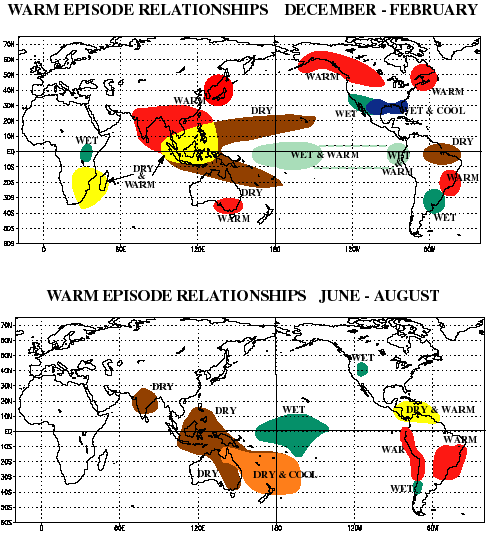
El Niño is a recurring warming of the central and eastern tropical Pacific. It shifts atmospheric circulation and can change weather risks far beyond the Pacific basin.

Signals to track

  • Niño 3.4 sea-surface temperature anomalies.
  • Trade wind weakening and convection moving eastward.
  • Regional rainfall and temperature departures.

Quelle: Wikimedia Commons El Niño regional impacts map · Aktualisiert 2026-07-29

🌀 Typhoon Naming Rules

How tropical cyclones are named, retired, and communicated across regions.

🌪️ Tropical Cyclone Classification

A practical guide to tropical cyclone wind scales and impact categories.

📚 Major Typhoon Archive

How major typhoon records are reviewed and compared across seasons.

🌊 La Niña Phenomenon

The cool phase of ENSO and its influence on seasonal rainfall and storms.

🔁 ENSO Cycle Explained

A clear explanation of El Niño, La Niña, neutral phases, and global teleconnections.

📈 Climate Change Data 2026

A practical weather-data lens on warming, heavy rainfall, drought, and urban risk.

🔥 Global Warming & Greenhouse Effect

The science behind greenhouse gases, warming trends, and weather extremes.

🌐 Glacier Melt & Sea Level Rise

How ice loss and ocean warming raise coastal weather and flood risks.

🌱 Carbon Neutrality Goals

How carbon-neutral plans connect emissions, energy systems, and climate risk.

⚠️ Extreme Weather Events Archive

A monthly framework for reviewing global heat, flood, storm, drought, and cold events.

🌡️ Heat Waves & Cold Waves Science

Why prolonged heat and cold happen, and how they affect health and infrastructure.

🌪️ Tornado & Thunderstorm Science

How instability, wind shear, and supercells create severe convective weather.

🌾 24 Solar Terms & Meteorology

How traditional seasonal markers relate to modern weather and climate observation.

🏙️ Urban Heat Island Effect

Why cities stay warmer and what reduces heat stress at street level.

🛰️ Weather Forecast Technology

From surface observations and satellites to numerical models and AI-assisted forecasts.